SCCM 2007, Machines auto-PXE boot when a mandatory advert for an OS deployment kicks off.
SCCM 2007, Machines auto-PXE boot when a mandatory advert for an OS deployment kicks off.
Hi,
We have collections which have mandatory OSD advertisements assigned to them but as soon as the machine restarts it automatically pxe-boots back into the front end screen rather than carrying on with the advertisement I have sent it. Now I could swear blind I have done this before and the job has carried on as expected rather than PXE booting back up and frankly shouldn't SCCM know that an advert has already started to run and should therefore ignore any pxe request? As part of the task sequence the computer is automatically removed from the collection at the end of the build but obviously it is not getting this far. As things stand I would imagine these are my options:
Remove the machine from the collection immediately as soon as the task sequence starts to run
Remove the pxeboot.n12 file from SMSBoot\x86
Change the advert to non-mandatory and then create some way to remotely kick it off
I guess my main question is should this be happening in the first place? If so, which of the options above (if any) would be the best choice? Are there any other options I have missed?
Thanks
Changed typeNiki HanWednesday, September 5, 2012 6:42 AM
Sharepoint 2010 - File Uploading to the Sharepoint Server from a Local Folder
Hi,
The following code uploads a file to the Sharepoint Server from a Local folder.
protected void Button5_Click(object sender, EventArgs e) { string uploadedFilePath = <Uploaded Path on Server Side> string sharePointListPath ="SharepointURL"; if (FileUpload1.HasFile) try { FileUpload1.SaveAs( uploadedFilePath + FileUpload1.FileName); Label1.Text = "File name: " + FileUpload1.PostedFile.FileName + "<br>" + FileUpload1.PostedFile.ContentLength + " bytes<br>" + "Content type: " + FileUpload1.PostedFile.ContentType; UploadFileToSharePoint( uploadedFilePath + FileUpload1.FileName, sharePointListPath + FileUpload1.FileName); } catch (Exception ex) { Label1.Text = "ERROR: " + ex.Message.ToString(); } else { Label1.Text = "You have not specified a file."; } } protected void UploadFileToSharePoint(string UploadedFilePath, string SharePointPath) { WebResponse response = null; try { // Create a PUT Web request to upload the file. WebRequest request = WebRequest.Create(SharePointPath); request.Credentials = CredentialCache.DefaultCredentials; request.Method = "PUT"; // Allocate a 1 KB buffer to transfer the file contents. // You can adjust the buffer size as needed, depending on // the number and size of files being uploaded. byte[] buffer = new byte[1024]; // Write the contents of the local file to the // request stream. using (Stream stream = request.GetRequestStream()) using (FileStream fsWorkbook = File.Open(UploadedFilePath, FileMode.Open, FileAccess.Read)) { int i = fsWorkbook.Read(buffer, 0, buffer.Length); while (i > 0) { stream.Write(buffer, 0, i); i = fsWorkbook.Read(buffer, 0, buffer.Length); } } // Make the PUT request. response = request.GetResponse(); } catch (Exception ex) { throw ex; } finally { response.Close(); } }
Melih Şimşek / Bilkent University
Edited byMelih ŞimşekMonday, September 3, 2012 2:13 PM
Consuming WCF Service issue
Hi All,
Facing the below error.
<<
System.ServiceModel.ProtocolException: The remote server returned an unexpected response: (405) Method Not Allowed. ---> System.Net.WebException: The remote server returned an error: (405) Method Not Allowed. at System.Net.HttpWebRequest.EndGetResponse(IAsyncResult asyncResult) at System.ServiceModel.Channels.HttpChannelFactory.HttpRequestChannel.HttpChannelAsyncRequest.CompleteGetResponse(IAsyncResult result) --- End of inner exception stack trace ---
Server stack trace: at System.Runtime.AsyncResult.End[TAsyncResult](IAsyncResult result) at System.ServiceModel.Channels.ServiceChannel.SendAsyncResult.End(SendAsyncResult result) at System.ServiceModel.Channels.ServiceChannel.EndCall(String action, Object[] outs, IAsyncResult result) at System.ServiceModel.Channels.ServiceChannel.EndRequest(IAsyncResult result)
Exception rethrown at [0]: at System.Runtime.Remoting.Proxies.RealProxy.HandleReturnMessage(IMessage reqMsg, IMessage retMsg) at System.Runtime.Remoting.Proxi
>>
Please help me.
Thanks UK
Reply:
Hi,
Please help me.
>>
System.ServiceModel.Security.MessageSecurityException: The HTTP request is unauthorized with client authentication scheme 'Negotiate'. The authentication header received from the server was 'Negotiate,NTLM'. ---> System.Net.WebException: The remote server returned an error: (401) Unauthorized. at System.Net.HttpWebRequest.EndGetResponse(IAsyncResult asyncResult) at System.ServiceModel.Channels.HttpChannelFactory.HttpRequestChannel.HttpChannelAsyncRequest.CompleteGetResponse(IAsyncResult result) --- End of inner exception stack trace ---
Server stack trace: at System.Runtime.AsyncResult.End[TAsyncResult](IAsyncResult result) at System.ServiceModel.Channels.ServiceChannel.SendAsyncResult.End(SendAsyncResult result) at System.ServiceModel.Channels.ServiceChannel.EndCall(String action, Object[] outs, IAsyncResult result) at System.ServiceModel.Channels.ServiceChannel.EndRequest(IAsyncResult result)
Exception rethrown at [0]: at System.Runtime.Remoting.Proxies.RealProxy.Hand
>>
Thanks UK
------------------------------------ Reply:
How you are trying to consume this service. BizTalk or .net application.
As per error Server is doing User authentication for which its throwing error NTLM. Use custom http binding and set the authenication property as per requirement. I would suggest better first understand what is wcf service security requirment and then do corresponding changes in bindings
Something like this
------------------------------------ Reply:
Hi, I got the below error if i go for it. << System.ArgumentNullException: Value cannot be null. Parameter name: key at System.Collections.Generic.Dictionary`2.Insert(TKey key, TValue value, Boolean add) at Microsoft.BizTalk.Adapter.Wcf.Runtime.WcfClient`2.CreateChannelFactory[TChannel](IBaseMessage bizTalkMessage) at Microsoft.BizTalk.Adapter.Wcf.Runtime.WcfClient`2.InitializeValues(IBaseMessage message) at Microsoft.BizTalk.Adapter.Wcf.Runtime.WcfClient`2..ctor(IBaseMessage message, WcfTransmitter`2 transmitter) at Microsoft.BizTalk.Adapter.Wcf.Runtime.WcfTransmitter`2.GetClientFromCache(String spid, IBaseMessage message) at Microsoft.BizTalk.Adapter.Wcf.Runtime.WcfAsyncBatch`2.BatchWorker(List`1 messages) >> Please suggest
Thanks UK
------------------------------------ Reply:
As i told you previously, before you start troubleshooting this issue please verfiy what is required from service side. If you don't have such information, it will be just guess work from client machine
------------------------------------ Reply:
For Negotiate NTLM, Unauthorised error, we need to do the following.
In the WCF BasicHttp adapter configuration, in the security tab, select security mode as TransportCredentialOnly and the TransportClientCredentialType as ntlm.
In case of Value can not be null, need to dig the SP whether it is asking some other type of data.
In my application, i want to inform the user whether the specified SharePoint2010 Farm passphrase is correct or not. In thise case, all the details, like Farm user details are available to me.
I searched in internet, but no luck. Do anyone suggest me on it?
Thanks in advance for suggestions.
Regards,
Ashok
Reply:
Even, i can execute 'psconfig.exe' or 'stsadm.exe' commands in my c# code.
Please let me know suggestions.
Regards,
Ashok
------------------------------------ Reply:
Hi,
I am able to achieve it with the below command and parameters. Is there any better approach than this?
i have one file that file how to movie one disk to another drive...
thanks
Thanks, Purna
Reply:
--tempdb USE master; GO ALTER DATABASE tempdb MODIFY FILE (NAME = tempdev, FILENAME = 'E:\SQLData\tempdb.mdf'); GO ALTER DATABASE tempdb MODIFY FILE (NAME = templog, FILENAME = 'F:\SQLLog\templog.ldf'); GO
---Set log file to 2gb size
ALTER DATABASE dbname MODIFY FILE ( NAME = dbname_Log , SIZE = 2000 )
Best Regards,Uri Dimant SQL Server MVP, http://sqlblog.com/blogs/uri_dimant/
I am at a CPLS this week teaching Dynamics SureStep so I will check if MB5-858 has second shot or not via the CPLS and Prometric
Microsoft Dynamics CRM Specialist and MCT www.vigence.co.uk
------------------------------------ Reply:
According to the reply I received from Microsoft Learning, vouchers are valid for exams with 070, 071 and 072 prefixes.
The link containing Dynamics information is for Microsoft Partner Network members only and should not have been made available to the general public. Steps will be taken to limit access to this URL.
When you see answers and helpful posts, please click Vote As Helpful, Propose As Answer, and/or Mark As Answer
Jeff, I am an MPN member which is maybe why I am able to get to that link
I am at a CPLS today and they seem to think Second Shot is available for all Dynamics exams
Microsoft Dynamics CRM Specialist and MCT www.vigence.co.uk
------------------------------------ Reply:
thanks
------------------------------------
Sharepoint 2010 - Uploading File from Global Network
Hi,
I am looking for file uploading class for 4 days, Finally I found :)
This code uploads a selected file into Sharepoint Document Library
if (FileUpload1.PostedFile != null) { if(FileUpload1.PostedFile.ContentLength > 0) { System.IO.Stream strm = FileUpload1.PostedFile.InputStream; byte[] byt = new byte[ Convert.ToInt32 (FileUpload1.PostedFile.ContentLength)]; strm.Read(byt, 0, Convert.ToInt32 (FileUpload1.PostedFile.ContentLength)); strm.Close(); // Open site where document library is created. using (SPSite objSite = new SPSite("Sharepoint URL")) { using (SPWeb objWeb = objSite.OpenWeb()) { SPFolder mylibrary = objWeb.Folders["DenemeForm"]; // Set AllowUnsafeUpdates = true to avoid security error objWeb.AllowUnsafeUpdates = true; mylibrary.Files.Add(System.IO.Path.GetFileName (FileUpload1.PostedFile.FileName), byt); } } }
Melih Şimşek / Bilkent University
Edited byMelih ŞimşekMonday, September 3, 2012 11:57 AM
Checking to see if a record exists and if so update else insert
I've decided to post this as a sticky given the frequency this question is asked.
For those of you wishing to build a package that determines if a source row exists in the destination and if so update it else insert it, this link is for you.
It's an awesome article - and I used this method in my 1st SSIS package.
However, if number of records is high (over 1000) the OLE Update Command performs slowly. So in that case you might better off loading source data to staging table and creating Stored Procedure which Updates then Inserts (and Deletes) data in the destination table.
Using Lookup transform in the way described in article is quite efficient (compared to other methods like merge join) - and can be useful in a variety of situations
------------------------------------ Reply:
TheViewMaster, Yes, very valid points. Each developer will have to decide based on the pros and cons of each method.
Personally, I wouldn't go to the extreme that you did, but would rather dump just the updates to a staging table and then outside of the data flow use an Execute SQL task to perform the batch update. I don't want to spend the cost to insert the data twice (once into staging table, and then again into the destination table using your idea).
------------------------------------ Reply:
Can somebody point me to a simple example of this.
I have a flat file and I want to check if the record exist in the file exist in the table, if it does I want to update and if it does not I want to insert.
------------------------------------ Reply:
This is very helpful. Thanks!
I am completely new to the SQL Server Integration Services. I went through your link and understand how you filter out diffrent records. Could you pointting out how you actually update you existing records ?
Thanks!
------------------------------------ Reply:
I have cloned the example above and it does not seem to be picking up the new or changed records. Is there any way to troubleshoot this.
------------------------------------ Reply:
I use OLE DB Command update the records. Thanks!
------------------------------------ Reply:
Hi phill,
Great article, I loved it.
This is what i had been looking for since long time.
One doubt is there in my mind, my current assignment i have to transform about 40K rows from a database.
Will this method work for me or there is any other better way.. ?
regards
Sudhir Kesharwani
------------------------------------ Reply:
Sudhir Kesharwani wrote:
Hi phill,
Great article, I loved it.
This is what i had been looking for since long time.
One doubt is there in my mind, my current assignment i have to transform about 40K rows from a database.
Will this method work for me or there is any other better way.. ?
regards
Sudhir Kesharwani
You need to likely send your changed records to a temporary table and then perform a batch update using an Execute SQL Task on the control flow. Using the OLE DB Command transformation isn't very efficient for high numbers of rows.
I have created a performance test package comparing the 2 methods: 1) stored proc with UPDATE and INSERT statements 2) Data flow using look up/conditional split
I have a data flow task to create a data test set with a variable number of rows (I used Jamie's script component source example) with IDs (used as PK) always ranging from 1 to nbrRows. Each row is constituted of 5 int, 4 string (10, 20, 40 and 80 characters) and 1 datetime with values chosen randomly.
So what I do is calling the package with nbrRows=1, 10, 100... The first time 1 new row is added. The second time, id=1 already exists so 1 row is updated, the other 9 are added. And so on... I then perform a second round of tests with the same numbers, the only difference being that the destination table is now full (therefore performing only updates).
What I've found out so far is that SSIS is faster only when inserting a certain number of rows (approx . 1000 to 100000). SSIS performed on avg. 30% better with 50000 rows while at 1 million rows, SQL performed better by 5%.
When the data was updated (second round), SQL was always faster.
Of course, these figures are based on my tests which may not reflect actual usage. I run SQL/SSIS in parallel, the tests are done in batch, .... I thought about using DBCC DROPCLEANBUFFER but it doesn't seem to change much.
Maybe my way of comparing is totally flawed... Have you ever tried comparing the two methods in terms of performance? How did you conclude the SSIS way is much faster??
Leonce
------------------------------------ Reply:
Leonce,
First, when using fast load option on the destination, there are two parameters which need to be adjusted based on the rows you are working with. Max Insert Commit Size and Rows Per Batch. What were the values for these set at?
Also note, that when possible, using a SQL Server Destination over the OLE DB Destination would be preferred.
SSIS should be no different than using BULK INSERT (it seems to be just a glorified wrapper to that). Performing updates via an OLE DB Command will always be slower than a batch update using SQL. (Only because the OLE DB Command is executed for every row in the data flow)
Phil
------------------------------------ Reply:
I left the default values for Commit Size and Rows Per Batch ('' and 0). You suggest I should adjust these values depending on the number of rows transferred? What would typical values be for a table with 100000 rows? Does it dependent on the row size?
I use OLEDB Destination, I'll try with SQL Server Destination.
I forgot to mention I use your method for updates (dump into table then update). Do you think SSIS can be faster than plain SQL for updates? I would tend to think it's impossible.
Leonce
------------------------------------ Reply:
fleo wrote:
I left the default values for Commit Size and Rows Per Batch ('' and 0). You suggest I should adjust these values depending on the number of rows transferred? What would typical values be for a table with 100000 rows? Does it dependent on the row size?
MICS should be set to whatever you wish the batches to be committed. So if you want to commit in 10,000 row batches, set MICS to 10,000. Rows Per Batch should be set to 100,000 in this case.
fleo wrote:
I forgot to mention I use your method for updates (dump into table then update). Do you think SSIS can be faster than plain SQL for updates? I would tend to think it's impossible.
True. Using an Execute SQL task will likely have a slight slowness to it compared to straight SQL, but in the end they do the same thing, so they should be REAL close.
------------------------------------ Reply:
Let us say that a package uses merge join option to insert new rows and it uses OLE DB Destination with fast load, table lock, and batch size (1000) options. The table lock option on the destination forces us to put a NOLOCK hint in the OLE DB Source query (on the destination table). Otherwise, they run into locking contentions (one is requesting exclusive table lock when the other is requesting shared table lock). This works most of the times but occationally I see that SQL Server does not honour the hint (one scenario: when the target table does not have a clustered index on the join key column) and runs into locking contentions. Have you seen this? Do you rely on NOLOCK hint too? Thanks for your help in advance.
------------------------------------ Reply:
bkallich wrote:
Let us say that a package uses merge join option to insert new rows and it uses OLE DB Destination with fast load, table lock, and batch size (1000) options. The table lock option on the destination forces us to put a NOLOCK hint in the OLE DB Source query (on the destination table). Otherwise, they run into locking contentions (one is requesting exclusive table lock when the other is requesting shared table lock). This works most of the times but occationally I see that SQL Server does not honour the hint (one scenario: when the target table does not have a clustered index on the join key column) and runs into locking contentions. Have you seen this? Do you rely on NOLOCK hint too? Thanks for your help in advance.
I don't use costly merge joins if I can avoid it because the data has to go through a sort upfront. Using a lookup component will cache the records first, before data has a chance to hit the destination table. With that said, I haven't used a merge join in my situations for checking to see if a record exists because the amount of rows hasn't been high enough for me to warrant avoiding the use of a lookup.
Any one tell me how to use "the batch update" as the solution above.
I have to update over 20.000 records by using cursor in a proc. It runs vey slowly.
Thanks
------------------------------------ Reply:
hoo....that a great article. really helps alot.
but however, i want to know can it be done between two different database? like between MySQL and SQL Server Mobile Edition?? well, you see...i have a system that uses MySQL in desktop and ive install the sql server mobile edition into my pocket pc. the question is ..can only selected data be transfer between those two? if yes, how? by the way, the system in desktop that uses the MySQL is alrdy a complete system and i hv been asked to build its mobile version, which is a TOTALLY new exprience to me. any idea???
thank you in advance. it would be very much appreciated. save my world.
------------------------------------ Reply:
Hi all,
I too tried using the same way. But i have strucked when i used oracle oledb provider for oledb command. i have got the following error. Error at Data flow task[oledb command[8717]]: An oledb error has occured. Error Code:0x80040E51. An Ole db record is available. Sourece:"OraOledb" Descrition:"Provider cannot derive parameter information and SetParameterInfo has not been called"
Unable to retreive destination column descriptions from the parameters of the sql command
Please help me in this regarding.
Regards, Roopa
------------------------------------ Reply:
hi Phil,
I am new this technology,thanks for sharing a good knowldge.
Its a great pleasure to get good knowledge from this forum.
maruthi
------------------------------------ Reply:
Well, i usually use 2 SQL Statements for this situation...
Till now, all other methods rather than this seem to affect performance. I know that probably my maintenance is not that user friendly but i know its efficient and old enough to be considered safe enough
Maybe in the future, MS will release a special task for this... Who knows? Or maybe we can start an opensource one... why not?
Best Regards,
------------------------------------ Reply:
Luis Simões wrote:
Well, i usually use 2 SQL Statements for this situation...
Till now, all other methods rather than this seem to affect performance. I know that probably my maintenance is not that user friendly but i know its efficient and old enough to be considered safe enough
Maybe in the future, MS will release a special task for this... Who knows? Or maybe we can start an opensource one... why not?
Best Regards,
Microsoft has implemented a MERGE T-SQL function in SQL Server 2008... That would also work.
I just wondering, if we have millions records of data, is it possible to use this method since it used to read each record ? I mean, I usually use Inner Join, Right Join and Left Join to find the deleted record, inserted record or updated record. How about the performance of this method comparing the Join method ?
Best regards,
Hery
------------------------------------ Reply:
JOINs are usually faster, assuming appropriate indexes exist. However, using lookups is extremely useful in situations where the source data is not in a relational table, or the source table and the reference table are on two different servers. Also, lookups cache data, so millions of rows aren't necessarily a problem.
------------------------------------ Reply:
Phil Brammer wrote:
Microsoft has implemented a MERGE T-SQL function in SQL Server 2008... That would also work.
It appears that the domain name for this URL has been, how do you verb this, "squatted upon".
Why do you say this? The link works fine for me. The DNS servers for the domain both respond, and return the correct IP address for the domain (along with the WWW record)
------------------------------------ Reply:
The site was down for a few hours (John Saunders alerted me to it - thanks again for that, John). I have the site hosted with one provider and the name registered with another one. For some reason, they choose not to make me aware that domain registration was expiring. It was fixed within about 3 hours of it going down, and should be good from this point forward.
------------------------------------ Reply:
Hi Phil, first of all, great post and many thanks for sharing this article.
I like a lot the first solution, which I addopted.
I just have a question to make. Since we do this lookup to see if it is an update or insert, in the data-flow, I would like to proceed to update and insert tasks. For insert, I use OLE DB DESTINATION inside of the data-flow (when we get the "error" from lookup). Till here, no problem.
But for update task, what you suggest? I think that I should take my key field, and update by this reference, right? but where? Can this be done at the end of this data-flow task, where there are the UNION ALL tasks? Or can this only be done outside data-flow, in the Control Flow, with SQL Task? If so, I should take in consideration, if data-flow ended with error or correctly, to know if it was an insert, or can I do the update respectively. Am I right, or I missed something here?
Thanks.
------------------------------------ Reply:
You can use an OLE DB Command to issue Updates inside the data flow. That can slow performance, though, since the updates are issued row by row. A better performing technique is to send the rows to be updated to a second OLE DB Destination so that they are saved in a working table, and then use an Execute SQL after the data flow to perform a batch update.
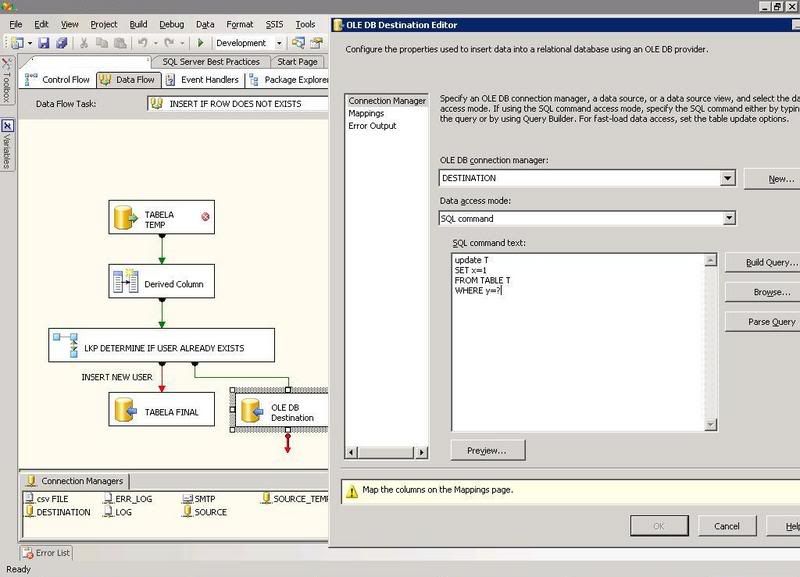
As we can see, I have the lookup before. The insert is working fine with the "error" from lookup. I just have a OLE DB DESTINATION to the table where I wanna insert and mapp the columns.
My problem is how can I make the update here. How can I make my sql to update (column x=1) where the line to be updated is equal to the column returned from lookup (y=?). That's the only way I can make the update right? Or the solution is something like:
UPDATE T
SET X=?
FROM TABLE T
WHERE Y=?
and the ? are ordered as the resultset coming from lookup, am I right? This means that first column must be the updatable column and the second ? must be the column_cod that is the key to update right?
Thanks in advance.
------------------------------------ Reply:
You can't do this. You will have to use an OLE DB Command Transform component instead.
As we can see, I have the lookup before. The insert is working fine with the "error" from lookup. I just have a OLE DB DESTINATION to the table where I wanna insert and mapp the columns.
My problem is how can I make the update here. How can I make my sql to update (column x=1) where the line to be updated is equal to the column returned from lookup (y=?). That's the only way I can make the update right? Or the solution is something like:
UPDATE T
SET X=?
FROM TABLE T
WHERE Y=?
and the ? are ordered as the resultset coming from lookup, am I right? This means that first column must be the updatable column and the second ? must be the column_cod that is the key to update right?
Thanks in advance.
In the second OLE DB Destination, you need to write the rows to a second, working table. Then you'd issue a batch UPDATE in an Execute SQL.
UPDATE table
SET colA = tableB.colA
FROM table, tableB
WHERE table.ID = tableB.ID
------------------------------------ Reply:
Any reason this was un-stickied? I think this should probably remain on the front page at all times...
------------------------------------ Reply:
Hi, all experts here,
I dont really understand why there is so many complex methods of checking a row to see if it exists or not.
Why dont we just use a Slowly Changing Dimension (SCD) component to sort it all out?
With SCD, by setting up the business key for the table where the records are in, we could easily check out if a record exists or not, and then if not, then the component will insert the new record for you.
If it exists, then we can update it with options to keep the historical records or not.
Is it a better way of dealing with it?
Looking forward to hearing from you for more advices.
Thanks.
Best regards,
------------------------------------ Reply:
Helen999888 wrote:
Hi, all experts here,
I dont really understand why there is so many complex methods of checking a row to see if it exists or not.
Why dont we just use a Slowly Changing Dimension (SCD) component to sort it all out?
With SCD, by setting up the business key for the table where the records are in, we could easily check out if a record exists or not, and then if not, then the component will insert the new record for you.
If it exists, then we can update it with options to keep the historical records or not.
Is it a better way of dealing with it?
Looking forward to hearing from you for more advices.
Thanks.
Best regards,
Helen,
In my opinion these methods are a lot simpler than the SCD component which hides all its internal machinations underneath a wizard. It also tried to do a lot more than what we need it to do here. Just my opinion.
The main problem with the SCD component is that it issues a SQL query for every row in the dataflow, it has no ability to cache data like the Lookup component does.
-Jamie
------------------------------------ Reply:
Jamie Thomson wrote:
Helen999888 wrote:
Hi, all experts here,
I dont really understand why there is so many complex methods of checking a row to see if it exists or not.
Why dont we just use a Slowly Changing Dimension (SCD) component to sort it all out?
With SCD, by setting up the business key for the table where the records are in, we could easily check out if a record exists or not, and then if not, then the component will insert the new record for you.
If it exists, then we can update it with options to keep the historical records or not.
Is it a better way of dealing with it?
Looking forward to hearing from you for more advices.
Thanks.
Best regards,
Helen,
In my opinion these methods are a lot simpler than the SCD component which hides all its internal machinations underneath a wizard. It also tried to do a lot more than what we need it to do here. Just my opinion.
The main problem with the SCD component is that it issues a SQL query for every row in the dataflow, it has no ability to cache data like the Lookup component does.
-Jamie
In line with Jamie's comment, one of the performance recommendations from Microsoft is to use a Lookup before the SCD transform to make sure it has less rows to process.
My opinion - if all you are doing is seeing if a row exists or not, the SCD transform is overkill. If you actually want to check each attribute for changes (to handle mixed Type 1 and Type 2 columns) the SCD transform might be worth it. Even in cases where I have used it, the first thing I do is delete the OLE DB Command the wizard creates and send the rows to a temp table so I can do a batch update.
------------------------------------ Reply:
Hello Phil, What you planted a year ago has is now full grown and helps someone like me who is new to enjoy the fruit. Thanks for all those who contibuted, making it easier for newbies like me.
------------------------------------ Reply:
Phil, Jamie and to all -
Thank you guys for sahring all your very wealthy knowledge and experiences regarding SSIS. All of you are the best! This forum became my bible since i started using SSIS. It indeed make a lot of difference...
Keep up the good work!
Concon
------------------------------------ Reply:
jwelch wrote:
JOINs are usually faster, assuming appropriate indexes exist. However, using lookups is extremely useful in situations where the source data is not in a relational table, or the source table and the reference table are on two different servers. Also, lookups cache data, so millions of rows aren't necessarily a problem.
Funny you should mention this. I was just debugging a package that does a lookup against a table with millions of rows. Watching the output window, I saw that the lookup was caching data for several minutes. Is this going to happen more quickly in subsequent runs of the same package, even though the table being referenced by the lookup is ultimately the table that will have new rows inserted into it by this same package?
Or is there a more definitive solution for testing and inserting only new rows into a table that contains millions of rows using SSIS? My first thought was to use variables to limit the scope of the lookup, but it looks like variables aren't available in the lookup component. That would be a nice improvement to future versions.
------------------------------------ Reply:
In 2005, the row caching will take the same amount of time each execution. In 2008, you can store the cache file between executions of the package.
------------------------------------ Reply:
jwelch wrote:
In 2005, the row caching will take the same amount of time each execution. In 2008, you can store the cache file between executions of the package.
I'm performing this insert on a table that contains over 150 million rows now, and will continue to grow at a fairly fast pace. I let my SSIS package run over night, and after caching just over 26 million rows, it errored out with a mysterious "OLEDB Error while populating internal cache".
I'm proceeding with the assumption that a lookup isn't a good idea on a table this size, and have two other ideas to try next:
1. Prefilter my datasource by doing a JOIN to the Destination table, and weeding out the duplicates in the source table that way.
2. Let the duplicates pass to the Destination, and ignore the error when the PK Constraint doesn't allow them to be inserted.
Any advice or warnings would be happily appreciated!
Perhaps the site was just down for a little while. (Conchango changed hands to EMC - note the new URL - but I was redirected successfully.)
------------------------------------ Reply:
Also, note that Jamie has moved on from EMC....
As such, I don't know that I would trust that link to be valid for too much longer; although I have absolutely no basis for this statement. I just have no clue what the norm would be for the average companies policies in regards to maintaining previous employees blog contents.
Please mark answered posts. Thanks for your time.
------------------------------------ Reply:
Thanks a lot, Link i back again :-)
------------------------------------ Reply:
Doing Insert and Update for millions of rows can be very time consuming and tedious job.
If some one want to do high peformance Upsert check component offered by Pragmatic works .. its called UPSERT component.
Hi, I had a question about the first article. (SSIS Junkie) I'm really new to SSIS, so please bare with me. I've gotten the package to work fine, and it does insert new rows, but it seems to me that the article has left out how to update rows if it finds an age that has changed? Can anyone tell me how I can update the changed ages after the union all task All Terminate Flow 2? Or if I am misunderstanding the article, can you tell me where the package updates rows? Thanks.
------------------------------------ Reply:
Hi, I had a question about the first article. (SSIS Junkie) I'm really new to SSIS, so please bare with me. I've gotten the package to work fine, and it does insert new rows, but it seems to me that the article has left out how to update rows if it finds an age that has changed? Can anyone tell me how I can update the changed ages after the union all task All Terminate Flow 2? Or if I am misunderstanding the article, can you tell me where the package updates rows? Thanks.
for some odd reason, i'm unable to pull up jaime's blog in my browser.
if you make a new thread, (perhaps) someone else can assist you. Duane Douglas, MCAD, MCITP | http://www.ssisbi.com | Please mark the post(s) that answered your question.
I wnat to know how can u do if-else check on variables at the start of package. Example: I have a varibale that's value is hard code in the package. Now i need to check what is it value. On that value I decide to do some processes like if 1-process1, 2-Process2, 3-process3 and so on I have some about 7 different processes that are based on that variable's value.
Syed, your question has nothing to do with the topic of this thread. Please ask a separate question instead of replying. John Saunders WCF is Web Services. They are not two separate things. Use WCF for All New Web Service Development, instead of legacy ASMX or obsolete WSE Use File->New Project to create Web Service Projects
------------------------------------ Reply:
Also, note that Jamie has moved on from EMC....
As such, I don't know that I would trust that link to be valid for too much longer; although I have absolutely no basis for this statement. I just have no clue what the norm would be for the average companies policies in regards to maintaining previous employees blog contents.
Given the past record of EMC Consulting (nee Conchango) for maintaining blog content between upgrades I definitely would not reply on it being around forever. Seriously - they have proved time and again that they are wholly incapable of managing it (and I say that knowing, and being friends with, the folks who manage it).
An important lesson for all - make sure you keep a backup of your own content.
Agreed if you doing Record load from SQL to SQL 2008 then Merge would make sense but that would require to load records on staging table first or you need to have source and target both on the same server.
On the other hand Upsert destination is designed for Any Source to SQL ..it can perform Bulk Insert or Update from ORACLE to SQL or Any source to SQL ...
I'd like a simple in SSIS way to insert values into a Lookup table if the values don't exist. I'm not worried about update.
At this stage, I'll probably have to create a Stored Procedure as I can't see how to return back to the main flow after the "no match" Lookup feature runs and updates the rows.
------------------------------------ Reply:
The above link is broken.
I'd like a simple in SSIS way to insert values into a Lookup table if the values don't exist. I'm not worried about update.
At this stage, I'll probably have to create a Stored Procedure as I can't see how to return back to the main flow after the "no match" Lookup feature runs and updates the rows.
Hi Peter,
Which link is broken?
I'm a little confused as you say you're not worried about updates but then you say you can't see how to return to the flow after the rows are updated. Could you elaborate?
Looks like that link is working again now - had gotten the classic Telligent community server error page.
I meant insert the rows. This is purely an insert based SSIS task - just insert missing lookups then insert the main table.
------------------------------------ Reply:
Looks like that link is working again now - had gotten the classic Telligent community server error page.
Yes, that doesn't surprise me. They always had trouble keep that site stable, I no longer work there so can no longer give them a friendly prod whenever its down.
I meant insert the rows. This is purely an insert based SSIS task - just insert missing lookups then insert the main table.
ok. So you say "I can't see how to return back to the main flow after the "no match" Lookup feature"..not quite sure what you mean by that because any rows in the "no match" output of the Lookup component are already "in the flow". Regardless, the rows in the "no match" output are the rows that you can consider as new and hence can be inserted into your target table using an OLE DB Destination component.
If anything isn't clear just reply - plenty of people here that are happy to help.
I have been deploying new applications with SCCM for a while now and it has gone well. No i am facing some upgrades of applications like Adobe Flash & Reader.
Here are some thoughts and questions i want answer to.
Do you uninstall the previous version of the application first? Usually you can just run the new version. If so, how? Run two programs? Script? Task Sequence?
What if the user is working in the application in question? Maybe the app just closes and the work wont get saved? will the installation fail? What will happen then?
I dont want direct answers, just want to know how you do it? :)
// Mr Clint Eastwood
Edited bySamus-AranFriday, August 31, 2012 2:22 PM
Reply:
Hi,
1. If I uninstall an application depends totally on how the installaton of the new version handles the upgrade. You should test that individually as in som cases user settings in the application could also get deleted if you uninstall an application. So I woulds say Upgrade when it works and uninstall/Install using a task sequence if it doesn't work to upgrade.
2. If the application closes or not is also individual so you should test that as well, when it comes to an application that is running you can choose how to do that if the upgrade doesn't handle it by itself,
Apps list: Still can't search folder names (concepts) + Horizontal alignment coming from semantic zoom bit off in RDS
1) Still can't search folder names (concepts in Start Screen)
Note! This was recorded during preview release - but has not changed. I.e. if you install for instance Ghostscript - where the programname will be ghostview - you can search for concept (folder name) of Ghostscript and find nothing in the apps list.
2) Horizontal alignment coming back in from semantic zoom is a bit off in RDS
Using semantic zoon in Apps list through RDS the horizontal alignment algo seems a bit off there - especially to the far right.
3) More on sematic zoon in Apps list (Winkey+Q) ... lacks may be some highlighting of retrieved results from the zoom
Otherwise, idea behind semantic zoom great to navigate those concepts (folder names) - however when you click a folder name or concept it would be nice if it was may be highlighted when you come back in to the complex view. Apparently the apss list is scrolled horizontally - but the mouse is not relocated to point out the location of the concept when you come back into the complex view from semantic zoom. What about touch screens?
May the background of the entire collection inferred by the concept should be highlighted - beyond the title. May be there should be more options or customizations for this. Just installing my basic software I have 300 shortcuts in Winkey+Q - so some grouping of "search results" in semantic zoom like highlighting would be great.
Changed typeNicholas LiMonday, September 3, 2012 8:33 AM
Changed typeNicholas LiMonday, September 3, 2012 8:33 AM
Reply:
Thanks for your valuable feedbacks.
Nicholas Li
TechNet Community Support
------------------------------------
SVG Compatibility
Why is there still no SVG compatibility in IE8 nor Windows Explorer in Windows 7? SVG is a open standard format.
It would be really nice if I could view SVGs from Wikipedia or other sources directly in the browser instead of saving them and opening them seperately. Also if I do save them, say for logos, I'd love for Windows Explorer to be able to preview/open them natively.
The first line of the page for the Adobe SVG viewer "Please note that Adobe has announced that it will discontinue support for Adobe SVG Viewer on January 1, 2009."
As of right now it isn't even supported. So again, Microsoft really needs to make Windows 7 have native support for SVG.
------------------------------------ Reply:
Any other news on this? No offense to DarienHawk67 or Joe Shonk, but I find "use a third party addon that is no longer supported" to not be a valid answer to the problem.
The answer also doesn't solve the problem of it not previewing in Windows Explorer anyway.
------------------------------------ Reply:
None taken. I actually agree with you. There should be native SVG implimentation in Win7 w/out having to use any third party utilities. Did you post this in the Comments as a request? If you do, I will +1 you.
------------------------------------ Reply:
While I agree that it would be nice if Windows 7 could do all things, I think it is unrealistic. For example, why not PDF, WinDjview. etc. I think that having to use third party apps for less than mainstream functions is not unreasonable.
------------------------------------ Reply:
Lead3 said:
While I agree that it would be nice if Windows 7 could do all things, I think it is unrealistic. For example, why not PDF, WinDjview. etc. I think that having to use third party apps for less than mainstream functions is not unreasonable.
SVG is an open standard. So it's no "less mainstream" than jpg. Only in less in adoption BECAUSE of IE's inability to render it.
Unrealistic? As far as Web Browsers, all the other ones: Firefox, Safari, Opera, Chrome etc can render SVGs without a third party addon. As far as Operating Systems, I know Linux previews SVGs in the file browser, not sure about OS X.
Also the third party (Adobe) application originally posted, is no longer supported.
DarienHawk67 said:
None taken. I actually agree with you. There should be native SVG implimentation in Win7 w/out having to use any third party utilities. Did you post this in the Comments as a request? If you do, I will +1 you.
I don't know where that Comments/Request section is that you speak of. I would definitely do that though. I believe I had done it through the "Send Feedback" button in Windows 7 itself.
------------------------------------ Reply:
Unfortunately, IE8 has been released and there is no SVG ability to it.
No VML in IE10 Standards and Quirks Modes The Internet Explorer-proprietary Vector Markup Language (VML) is no longer available in IE10’s standards and quirks modes. Web developers are advised to use standards-based Scalable Vector Graphics (SVG) instead. VML is still available in IE10 in legacy modes 5, 7, 8, and 9 though the performance of VML in those modes is inferior to SVG.
------------------------------------ Reply:
Sorry to bring up this old post, but for the sake of completion id like to add that .svg will be supported in IE10:
Which is nice to know, but it's now September 2012. Most companies (mine included) are still stuck in IE8, and Microsoft still hasn't attempted to add .svg support to IE8 or IE9. That's 20% of internet users who still can't use svg, as Microsoft wanted us to use Silverlight, which they've quietly let die.
Ironically, I was looking to use svg, as IE8 also doesn't support HTML 5, and I thought perhaps Microsoft would've at least for SVG working with IE8 by now. Err, no.
No prizes for guessing why so many people turn to Chrome when they choose a browser for their home PCs...
------------------------------------
Will deleteing active database copy in DAG delete the Passive copy as well
Hi,
Just wanted to know deleteing active database copy in DAG delete the Passive copy as well?
Reply:
Why do you need to delete the active copy. make the active copy as passive and then delete.
Regards, Prabhat Nigam XHG and AD Architect and DR Expert Website: msexchangeguru.com VBC: https://www.mcpvirtualbusinesscard.com/VBCServer/wizkid/card
------------------------------------ Reply:
I dont want to delete the active copy.I just wanted to know what effect it can have on passive copy.
I dont have a test setup now to test this.And i could not find the answer anywhere.
------------------------------------ Reply:
Hi,
The option to remove the active copy is not present in the EMC - therefore you can only remove passive copies.
Can the active database copy be deleted usign Exchange Management Shell?
What if accidently the LUN containing the active database copy is deleted.Will that delete the Passive copy as well?
------------------------------------ Reply:
If LUN has been deleted then active will be in failed state which means DB is missing and other passive will become active.
Regards, Prabhat Nigam XHG and AD Architect and DR Expert Website: msexchangeguru.com VBC: https://www.mcpvirtualbusinesscard.com/VBCServer/wizkid/card
------------------------------------ Reply:
ok....Thanks all of you....
------------------------------------
What is ILM and how it can be used in exchange mailbox migrations.
What is ILM and how it can be used in exchange mailbox migrations.
Reply:
ILM is a useful tool when you deploy Exchange 2010 in a cross forest infrastructure. ILM is capable of building disabled accounts at Target forest to create linked mailboxes. ILM helps you to synchronize address book, availability etc. across the forests.
I could not find any documentation that provided a clear answer if this would work or not so I decided to just try it.
I have multiple distribution points in SCCM 2007, some standard and some branch. I am moving to SCCM 2012 but not really using migration. However, in some location I have the need to use the same server for the SCCM 2012 distribution point.
In order to ensure content is immediately available when I upgrade clients in a location, I wanted to actually have SCCM 2007 and SCCM 2012 store their package content on the same server. Once our upgrade is complete, I would go back and remove the server as a distribution point in SCCM 2007.
Turns out it works just fine so far. My only concern will be if when I remove the server as a distribution point in SCCM 2007 if it will mess up the SMSPKGx$ shares which currently contains content for both sites.
Reply:
It's not supported to share servers between different ConfigMgr sites (exception: migration and DP sharing).
Instal PHP 5.4.6 on IIS 7 to work with MS SQL 2008
Many people are asking here for a help how to install this combination. As an appreciation for a help I received in this forum I decided to describe our way and I hope it will help others.
Additional twist is a use of ADODB (http://adodb.sourceforge.net/) with 'mssqlnative' driver which uses new MS SQL PHP driver to connect to database.
-- Partner at Deep Shift Labs. We are building Nerrvana - Selenium cloud at your fingertips and Startyco - pluggable web apps for start-ups.
Edited byIgor KryltsovSunday, September 2, 2012 3:33 AM
Changed typeIric WenMonday, September 3, 2012 6:07 AM
Reply:
Hi Igor,
Thanks for sharing, I will change this thread type to discussion.
Best Regards, Iric Please remember to mark the replies as answers if they help and unmark them if they provide no help.
------------------------------------
Windows 7 Professional slow shut down
Hi,
I am experiencing a problem with one of my clients, all there Windows 7 machines struggle to shutdown when connected to the Windows server 2008 R2 domain. However when working not connected to the domain the machines shutdowns correctly
Site info:
Forest/ Domain level: Windows Server 2008 r2
Client has trust with another company, both sites are experiencing the problem
DCdiag results are fine, no errors.
Disabled the with to cache setting but still a problem.
Any assistance will be greatly appreciated.
Reply:
Hi. I have never had an issue with windows 7 shutting down. But if I did I would first be inclined to take a look here:
Thanks! Symon Perriman Program Manager II Clustering & High-Availability Microsoft
SymonP_MSFT
Reply:
Hi Symon,
I heard the it is a bad idea to configure IIS 6.0 on a server 2003 failover cluster that has sql. Is that true? I need to configure indexing service on a cluster environment that's running sql server 2005. Any advise or links will help me. I did find an article related to this but its for windows 2000: Article ID 292542 Thanks.
Mike
------------------------------------ Reply:
Great resource. Thanks for that.
------------------------------------ Reply:
Thanks Symon
Ultimate resource.
Regards
Ashish Jaiman
------------------------------------ Reply:
Thanks Symon , dat's a grt idea
Warm Regards,
Pankaj
------------------------------------ Reply:
wow great resource..Thanks for sharing.Every second counts..make use of it.
Deployment of printers from Server 2008 to windows 7 client computers
We are using server 2008 in a school setting. We recently updated all computers to windows 7. We are having an issue that we did not have with XP. We have one Group policy for printer deployment for both students and faculty, applied to the user. It is the same group policy that was used for XP clients and worked fine. Every computer is exactly the same. When users log in: there is a range from 2 to 7 printers being deployed. I have all seven deployed to my account, another teacher may have 3 deployed to his account and another teacher 6 printers deployed. It is completely random as to who has which printers. I know it is not a security issue because under XP, all teachers received all printers. Nothing was changed in the GP. Does pushprinters.exe that was required under XP cause any issues? I am completely baffeled.
Changed typeJeremy_WuMonday, September 10, 2012 9:41 AM
Reply:
Hi,
As the issue is related to Printer Deployment, it is recommended to post the issue in related forums for better assistance.
Thanks for your understanding and hope the issue will be resolved soon!
Regards.
Jeremy Wu
TechNet Community Support
------------------------------------
No audio in Windows Store applications
I am using a Samsung Series 7 tablet and I do not have any audio in the Windows Store applications, but audio works fine in the desktop applications like Windows Media Player. I installed Windows 8 RTM from the network installer (DVD install failed).
After visiting the Samsung support site, I upgraged the audio drivers with no change (audio still does not work in Microsoft Store apps).
I decided to back up the installation and do a refresh, but the back up software complained that I was not an administrator (which is incorrect), so I created a local admin account (I was using a Microsoft login account). After creating the local login, I decided to test the audio and discovered that all audio worked for the local login.
I would prefer to use my Microsoft login because of the convenience it provides, but for the moment, the only way I can get full functionality is to use the new local account.
I am not sure what this means, but hopefully someone on this forum can make sense of it.
Moved byDavid WoltersTuesday, May 21, 2013 9:49 PMMoving to a more appropriate forum
Reply:
Hi,
Try to add your Microsoft account to administrators group. If the issue persists, try to login with local admin account and rename your Microsoft account profile, and then use Microsoft account login again for test.
Or you can remove your Microsoft account and re-add it again.


No comments:
Post a Comment